

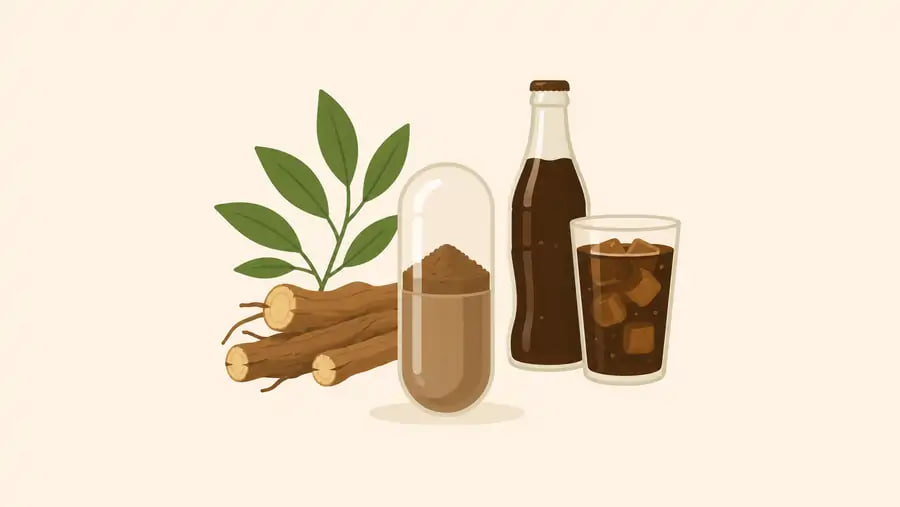
Why sarsaparilla capsules do not taste like soda becomes clear when you separate a botanical ingredient from a finished beverage. Capsules usually contain ground sarsaparilla root, root material, or a dry extract. Sarsaparilla soda is a sweetened, flavored drink that may combine several botanical flavors, spices, acids, sweeteners, and carbonation.
The familiar soda profile does not come from plain root powder alone. Vanilla-like sweetness, wintergreen notes, licorice, spices, molasses, caramel, and added flavors can all shape the final drink. Secrets Of The Tribe treats the capsule and the beverage as different product categories rather than two forms of one flavor.
A capsule that smells earthy, woody, mildly sweet, bitter, or almost neutral is not automatically weak or mislabeled. Taste and aroma depend on the species, plant part, processing method, extract type, capsule shell, storage, and added ingredients.
Why do sarsaparilla capsules taste different from the soda?
Sarsaparilla capsules taste different because they usually contain a relatively plain botanical material. The soda is a formulated flavor experience.
A capsule may contain:
- Ground sarsaparilla root.
- Powdered rhizome or underground plant material.
- A concentrated dry extract.
- A blend containing sarsaparilla and other herbs.
- Flow agents or capsule-processing ingredients.
A bottled drink may contain:
- Water.
- Sugar, syrup, or another sweetener.
- Carbonation.
- Natural or artificial flavors.
- Caramel color.
- Acidulants.
- Vanilla, licorice, wintergreen, birch, spice, or root-beer-style flavor notes.
The botanical powder therefore represents one ingredient or extract. The soda represents a complete recipe designed to taste sweet, aromatic, and refreshing.
| Feature | Sarsaparilla capsules | Sarsaparilla soda |
|---|---|---|
| Product category | Dietary supplement | Sweetened beverage |
| Typical form | Root powder or dry extract | Flavored carbonated liquid |
| Sweetness | Usually little or none | Usually added through sugar or sweeteners |
| Aroma | Earthy, woody, herbal, mild, or bitter | Sweet, spicy, vanilla-like, wintergreen-like, or root-beer-like |
| Flavor source | Botanical material and capsule ingredients | A blend of flavoring ingredients |
| Interchangeable? | No | No |
What is sarsaparilla root?
Sarsaparilla is a common name applied to several climbing plants in the genus Smilax. These plants belong to the family Smilacaceae.
Species associated with commercial or historical sarsaparilla include Smilax ornata, Smilax officinalis, and other regional members of the genus. The exact species should appear on a well-documented supplement label or product specification.
The underground parts are commonly used as botanical raw material. Depending on the species and supplier, a label may call the material root, rhizome, or root and rhizome.
The natural sensory profile can include:
- Earthy notes.
- Woody notes.
- Mild sweetness.
- Low aromatic intensity.
- Bitterness.
- A dry or slightly astringent finish.
This profile is subtler and less dessert-like than a commercial soft drink.
The common name does not identify one universal species
The word sarsaparilla may refer to more than one Smilax species. Two products can therefore use the same common name while containing different botanical species or materials from different regions.
The scientific name and plant part provide more useful identity information than the front-label flavor name alone.
What creates the familiar sarsaparilla soda flavor?
The familiar soda flavor usually comes from a blend rather than one plain root ingredient. Beverage makers balance sweet, spicy, creamy, mint-like, woody, and caramelized notes to create a recognizable root-beer-style profile.
Possible flavor contributors include:
- Sarsaparilla root or sarsaparilla flavor.
- Vanilla.
- Licorice root.
- Wintergreen.
- Birch-derived flavor.
- Ginger.
- Cinnamon.
- Molasses.
- Caramel.
- Clove or other spices.
Recipes vary by brand and region. Some beverages may use real botanical extracts. Others may rely mainly on compounded natural or artificial flavors.
Carbonation also changes the experience. It lifts aroma, creates acidity, and produces the sharp sensation associated with soda. A dry capsule contains none of those features.
Was sarsaparilla the only ingredient in historical root-style drinks?
No. Historical root-style beverages commonly used combinations of roots, bark, herbs, spices, sweeteners, and fermentation ingredients.
Sarsaparilla could be one component, but it was not always the only source of flavor. Sassafras, birch, wintergreen, licorice, ginger, molasses, and other materials appeared in different formulas.
This matters because modern flavor memory comes from the complete drink. A person may associate the word sarsaparilla with vanilla, caramel, wintergreen, and sweetness even when those notes came partly or mainly from other ingredients.
The editorial position at Secrets Of The Tribe is to distinguish the botanical from the beverage recipe. The supplement should be evaluated by its label and specifications, not by whether it reproduces a nostalgic soda flavor.
Why can sarsaparilla powder smell weak inside a capsule?
Dry root powder may release less aroma than a liquid flavor system. Many of its compounds do not evaporate readily at room temperature.
The capsule shell also limits exposure to air. When the bottle opens, you may smell the container, capsule material, desiccant, or other ingredients before detecting the root itself.
Other factors that affect aroma include:
- Particle size.
- Drying temperature.
- Age of the botanical material.
- Storage before encapsulation.
- Extract concentration.
- Capsule shell material.
- Moisture protection.
- Added flow agents.
- Individual smell sensitivity.
A mild aroma does not prove that the capsule contains too little root.
Why can a dry extract taste different from plain root powder?
A dry extract and plain root powder are different preparations.
Root powder contains milled botanical material. A dry extract is produced by exposing plant material to a solvent, separating the liquid extract, and removing much of the solvent to create a concentrated powder.
The extraction method can change which constituents remain in the final ingredient. It can also change color, texture, smell, bitterness, and solubility.
| Label term | What it usually describes | What it does not prove |
|---|---|---|
| Root powder | Milled botanical material | Soda-like flavor |
| Root extract | Selected soluble fraction of the root | A specific concentration without more details |
| Extract ratio | Relationship between starting material and extract | Expected aroma intensity |
| Flavored capsule | Product with added flavor ingredients | Greater botanical content |
| Sarsaparilla flavor | A beverage-style flavor designation | Presence of a specific Smilax species |
Does the absence of soda-like aroma mean the capsules are fake?
No. The absence of a sweet, vanilla-like, or wintergreen-like aroma does not prove that the capsules are fake.
A genuine root powder can smell earthy and restrained. A dry extract may smell different again. A sweet beverage aroma usually requires additional flavoring and sweetening ingredients.
Botanical identity should be assessed through:
- The scientific name.
- The declared plant part.
- Supplier documentation.
- Raw-material specifications.
- Identity testing.
- Lot traceability.
- The complete ingredient panel.
Smell can support an organoleptic description, but it cannot independently confirm species, purity, concentration, or authenticity.
Does a stronger root-beer smell mean a better supplement?
No. A stronger root-beer smell may come from added flavoring rather than more sarsaparilla.
A manufacturer could add vanilla, wintergreen, licorice, or another aromatic ingredient without increasing the amount of root. Another manufacturer could provide unflavored botanical powder with very little recognizable beverage aroma.
Aroma does not prove:
- Higher root content.
- Greater extract concentration.
- Better freshness.
- Accurate species identification.
- Lower contamination risk.
- Suitability for an individual.
- Expected results.
Compare products through their botanical identity, amount per serving, preparation type, other ingredients, and available testing information.
Can you taste the capsule powder to test its quality?
Taste should not be used as a quality test. Sensory impressions are subjective and cannot quantify the botanical ingredient.
Opening a capsule may also conflict with the product directions. Some capsule contents taste unpleasant, irritate the mouth, disperse easily as dust, or use ingredients designed to be swallowed inside the shell.
Do not open or taste a capsule unless the label permits it or a qualified professional has advised that the specific product can be used that way.
Even when tasting is allowed, sweetness or bitterness cannot confirm purity, potency, freshness, or safety.
Sarsaparilla Capsule Label Checklist
Use this checklist when capsules do not smell or taste like bottled sarsaparilla. It helps separate the botanical ingredient from the flavor profile of a commercial drink.
Find the scientific name
Look for a complete Smilax species rather than relying only on the common name sarsaparilla.
Check the plant part
Confirm whether the product uses root, rhizome, root and rhizome, or another declared part.
Identify powder or extract
Determine whether the capsule contains milled botanical material or a processed dry extract.
Review the amount per serving
Compare equal serving sizes and check whether the milligrams refer to root powder, extract, or a botanical equivalent.
Read the complete ingredient list
Check for flavors, sweeteners, spice extracts, fillers, flow agents, and capsule materials.
Separate supplement from beverage
Do not expect plain root powder to reproduce carbonation, sweetness, vanilla, wintergreen, or caramel notes.
Check dates and storage
Review the lot number, best-by date, container seal, desiccant, and storage instructions.
Do not rank products by aroma
A stronger smell does not establish higher sarsaparilla content or better quality.
Treat missing details as unknown
When the species, plant part, or preparation is absent, contact the manufacturer rather than guessing from flavor.
When can a different smell indicate a product problem?
A capsule does not need to smell like soda, but an unexpected change within the same bottle can deserve attention.
Check the product when you notice:
- A broken or missing seal.
- Moist or sticky capsules.
- Visible mold.
- Strong rancid or rotten odor.
- Unexplained discoloration.
- Capsules fused together.
- Water damage.
- Insect contamination.
- Storage outside the labeled conditions.
Do not taste a suspicious product. Keep the bottle, lot number, and purchase information available when contacting the manufacturer or seller.
Are sarsaparilla capsules and soda nutritionally equivalent?
No. Capsules and soda are different product categories with different ingredients and serving systems.
A soda may provide sugar or another sweetener, water, flavors, acids, and carbonation. A supplement capsule may provide root powder or extract in a measured serving.
Drinking more soda does not create an equivalent supplement serving. Taking more capsules does not reproduce a beverage flavor or experience.
Use each product only according to its label. This article explains product differences and does not recommend a capsule serving or dietary use.
FAQ
Should sarsaparilla capsules taste like sarsaparilla soda?
No. Capsules usually contain root powder or extract, while the soda uses sweeteners, flavor blends, and carbonation.
Why do sarsaparilla capsules taste earthy?
Ground root and dry extracts naturally have more earthy, woody, herbal, or bitter notes than a sweetened beverage.
Does a weak aroma mean the capsules are low quality?
No. Aroma depends on species, processing, storage, extract type, capsule shell, and volatile-compound content.
Does sarsaparilla soda contain real sarsaparilla root?
Some products may use botanical extracts, while others rely mainly on natural or artificial flavor systems. Check the beverage ingredient list.
Is sarsaparilla the same as root beer?
No. They are related beverage styles, but recipes and naming vary by region and manufacturer.
Why does sarsaparilla soda taste like vanilla or wintergreen?
Those notes may come from added vanilla, wintergreen, licorice, birch, spices, or compounded flavorings.
Can smell confirm that a capsule contains real sarsaparilla?
No. Botanical identity requires the scientific name, plant part, documentation, and appropriate testing.
Can I open a capsule to compare the flavor?
Only when the product directions permit opening it. Taste still cannot confirm potency, purity, or quality.
Glossary
Botanical identity - Confirmation of the plant species and plant part used in a product.
Carbonation - Dissolved carbon dioxide that creates bubbles, acidity, and a sharp mouthfeel in beverages.
Dry extract - A powdered ingredient produced by extracting plant material and removing most of the solvent.
Extract ratio - The stated relationship between the starting botanical material and the finished extract.
Flavor profile - The combined taste and aroma characteristics of a food, drink, or ingredient.
Organoleptic evaluation - Assessment through appearance, smell, taste, and texture.
Root powder - Dried root material milled into a fine powder.
Sarsaparilla - A common name used for several climbing plants in the genus Smilax and for a flavored soft drink.
Smilax - A botanical genus containing species commonly called sarsaparilla.
Wintergreen - A mint-like flavor associated with methyl salicylate and often used in root-beer-style flavor profiles.
Conclusion
Sarsaparilla capsules do not taste like soda because root powder or extract is only a botanical ingredient, while the drink is a sweetened and flavored recipe. Missing soda-like aroma does not by itself indicate weak, fake, stale, or poor-quality capsules.
Sources Used
Accepted botanical record and distribution for a species commonly associated with sarsaparilla, Smilax ornata Lem. - powo.science.kew.org/taxon/urn:lsid:ipni.org:names:541693-1
Accepted botanical record and food-use information for another sarsaparilla species, Smilax officinalis Kunth - powo.science.kew.org/taxon/541685-1
Overview of the accepted Smilax genus and its botanical family, Smilax L. - powo.science.kew.org/taxon/urn:lsid:ipni.org:names:30001535-2
Requirement to identify the plant part used in botanical dietary supplements, Dietary Supplement Labeling Guide: Chapter IV - fda.gov/food/dietary-supplements-guidance-documents-regulatory-information/dietary-supplement-labeling-guide-chapter-iv-nutrition-labeling
Dietary supplement identity and botanical ingredient-labeling requirements, Statement of Identity, Nutrition Labeling and Ingredient Labeling of Dietary Supplements - fda.gov/regulatory-information/search-fda-guidance-documents/small-entity-compliance-guide-statement-identity-nutrition-labeling-and-ingredient-labeling-dietary
General definition and labeling framework for dietary supplements, Dietary Supplement Labeling Guide: Chapter I - fda.gov/food/dietary-supplements-guidance-documents-regulatory-information/dietary-supplement-labeling-guide-chapter-i-general-dietary-supplement-labeling
Historical overview of botanical ingredients used in root-beer-style beverages, Root Beer: The Quintessential American Soda - homebrewersassociation.org/beyond-beer/root-beer-the-quintessential-american-soda